ラベル Art の投稿を表示しています。 すべての投稿を表示

2010年9月9日木曜日

Teshima Sense by Chiyoko Todaka on Teshima


When you go down a hill to the sea from "Karatono Shimizu", you can see a pond and a lot of feathery objects dancing on the pond. That’s Chiyoko Todaka’s art work..
The objects are made from plastic fibers. They spin around and swing together in the breeze. Even with no wind, they swing softly. I think they are born from this pond and they don’t have clear form just like atmosphere.
Fortunately, I had a chance to hear about this art work from Chiyoko Todaka
She told me that she wanted to present something inspiring from this place. She said, each place has its own fascination. She believes we can’t explain it, we can only feel it sensuously, and she is happy when people feel it.
From her story, I think that her style is very natural. Now, a lot of artists create art works on purpose, for sale. They might suffer from the gap between the commercial ism to make a living and their instinct as an artist.
I hope that artists’ feelings are chosen over money.

In the Air by Noe Aoki on Teshima

“Karatono Shimizu”which is a famous fountain of Kagawa , is the focus of” in the Air”, Noe Aoki’s art work.
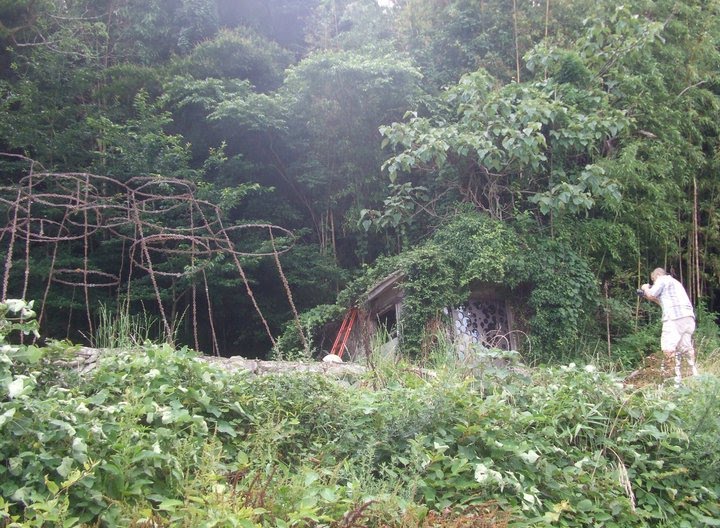
“Karatono Shimizu” is located at the base of Danyama,
Around 1000 years ago, when Kouhoutaishi, a high priest, of the Shingonsyuu, one of the schools of Buddism, came to this place, had thirst and dug in the ground , and then suddenly, fresh water sprung up. Even now, fresh water springs up from this fountain and is used as a local water source and a source for irrigation.
Noe Aoki installed a beautiful panel into the fountain. This panel, which has a lot of mottled circles clipped out of metal, has a design that seems like bubbles.
There is also a sculpture next to the fountain. It is a larged size work over 2 meters, but I didn’t feel it’s weight. It consists of thin iron wires, built in elliptical shapes that look like they are soaring into the air. If you look carefully, it consists of many welded round irons. These shapes also remind me of air and water, and the history of this place, protecting by local residents.Noe Aoki also might be presenting what she saw, and created a fusion of her art work and nature.

2010年8月19日木曜日

"Father memory" by Chiharu Shiota on Teshima

Chiharu Shiota, who was born in Osaka in 1972, has been based in Berlin
since 1996.
Her art work, “Father memory” is installed in an abandoned Auditorium. Many years ago it was used as an elementary school, Which many people attended. The school building was destroyed,
and only the auditorium and some rusty play equipment still remain.

When she visited there the first time, she might have imagined the sound of children laughing and people: rice planting and harvesting rice. This place is where old memories can be conjured up in our mind.

For creating the work, she gathered from 500 to 600 various types of window frames from Teshima and Naoshima, to make a big tunnel with assorted window frames in the middle of the auditorium. When you stand in the play ground, and to look at the auditorium, you can see the idyllic scene through the big hole of the tunnel.
The scene might inspire you to think of the past, where people have seen at one time.
When close to the tunnel, the window frames are arranged in a very fine balance; big and small, dark color and light color, and even space balance. I think that she has a good sense of art.
All of a sudden, I remembered the time which I saw her art work ” the room of memory” in the Kanazawa 21th century museum.
In there, huge window frames, painted white, were combined like a wall, and it created a distinctive world.
I’d felt like wandering into the past, where it was quiet and time was stopped. Actually, I could see the past through each window frame.
Window frames are daily products we use. I was surprised that window frames, not such special things, could cause us a great impression.

When I’ve faced her art works, some how, I’ve evoked my worries and aaaaaaaaathe room of memory 2009
loneliness and the limited time of my life. In my busy day, time goes so fast, and I don’t even think about it. I need to realize the remaining time, to live a more meaningful life.

2010年8月12日木曜日

"島キッチン" Shima Kitchen by Ryo Abe on Teshima

In the Setouchi art festival, a lot of new art spots have been created on many islands, especially on Teshima. This island is of great importance due to the 17 art works created there.
A restaurant, “ Shima Kitchen ” was planned on Teshima as a place, where residents, volunteers and tourists, can talk, enjoy music or watch a play. Shima Kitchen was designed by the architect, Ryo Abe.
http://www.aberyo.com/
He made the whole house over and built an unique terrace with burned cedar roofs. I washed the roofs as a volunteer. It was very hard work. Shima Kitchen is well designed, very simple but successfully integrates the old and new.
Shima Kitchen was built encompassing the living trees around it.
I like that style.
We use a lot of materials, lands, trees, clay, stone, to build a living space. We human beings just consume a lot of things from nature, but I think that we’re usually getting power from nature, I believe we can coexist with nature.
The symbolic tree at Shima Kitchen is the fig. The fig has a meaning of immortality. I hope to live long, and with all living nature.
The main menu of Shima kitchen is a Keema curry, some how, women living in Teshima have been cooking Keema curry, and it has become a local food of Teshima.. To Shima kichen, famous chefs have come from "Tokyo Marunouchi Hotel", and every day they are planning the menu based on the available food. Some local women and volunteers are helping by serving.
http://shimakitchen.com/calendar/
When I’m sitting at the terrace of Shima Kitchen, I remember my old working place, a rural backwoods area where a lot of people had lived at one time. In Japan, due to urbanization, local areas have been suffering from a declining population.
This has caused the change of family form and the loss of their local cultures and demise of local communities. Through volunteering, I became to reflect on thing, what is a good point of our local community, and what I can do for my local area, and I’ve realized that I should decide where I’ll live.
Now, Shima Kitchen is a bustling and hot spot on Teshima, because there are a lot of attractive elements; a well-designed restaurant, famous chefs and the art festival.
During this art festival, I hope that the people living on Teshima gather and discuss Teshima’s future.

2010年8月2日月曜日

"Luck Exists in the Leftovers" by Clair Healy & Sean Cordeiro on Teshima

Claire and Sean have been working fifty-fifty in Austallia and Germany.
Their collaborative art work is "Luck Exists in the Leftovers".

Their art work is in a very beautiful old house, covered by ivy. When you go through the gate, you will see large holes in the ground. Huge soils splash around holes, like coming out something from the holes. A stone passage leads to the narrow entrance of the house. The entrance hall is dim, just a simple earth floor. Looking to the right, a fossil dinosaur caruches your eye.

It is really just a fossile dinosaur, but looks on the verge of moving.
The dinasour is bonded with tons of fixtures and boxes. The boxes used were used and forgotten, the regidents gathered for this project.
At one viewing, you can imagine all kinds of stories; like an exacavated dinosaur entered the old house, and bond with old posessions to gain strength.
At the begining, I just enjoyed to imagine this story. After talking with Claire and Sean, I was suprised that they had more deepl thoughts for their art work.

There are a lot of beautiful abandoned houses, and in them. there are also large amounts of possesions, funiture, plates and utensils, kimonos・・・・. They still have worth, they hace just been forgotten. Claire and Sean give people opputunity to rethink the vaule of these possessions. The other side of the coin is that the value varies according to times or individuals.

They have been creating art works which relate to social issues, like mass production and consumption or environmental issues.
We usually buy easily, without considering. But We don't need such a lot of things to live. We may waste precious resorces. When we rethink what we need, we can find out what we really need.
I hope people, like artists, architects, producers, creating smething, aaaaaaaDeceased Estate 2004
to have these idea, why, or for what porpose.
I believe they can promote these idea to students and the world.

Well, Their art work is in Kou of Teshima.
Fortunately, you can look some happy accidents, cactus on every where or swallow babies. you also may give some fortunes.

2010年7月28日水曜日

"Harmonica" by Sue Pedley on Teshima


Sue Pedley's art work is my first volunteer activity.
The title of Sue's art work is "Harmonica".
Sue based in Australia, she became popular in Japan after the sucess of the Tumari art festival in 2009.

When Sue visited an old house in Teshima, there were tons of possessions: furniture, a sewing machine, plates, cups, utensils, and the goods necessary for everyday life; which a family lhad eft in the old house. They remain in there, like waiting for their owner to come back.
There were many handmade clothes and fabric in the closets and chests. They were made and collected for the family by some woman. Family memories was etched in everything. When Sue opened one closet, she heared the sound of a hamonica, like it was telling the family is memories.

I think that she was inspired by this closet, connecting the past and the present, the family and her.
She started to try to make a huge net for covering the old house, and wraped all plates and cups in fabric. A lot of people; Sue, local residents and volunteers, took part in this project, telling about their own stories.
While knitting the net, they also enhanced their relationship. It was the restoration of a local community and the creation of a new volunteer community.

Now, the old house, covered by the net, is standing on the high land in Kou of Teshima, holding the family's memorilia. It is looking to the sea, beatiful and calm.
On the first encounter, I expected a double meaning, harmonica and harmony, from the title "harmonica". And that is what I found.

2010年7月21日水曜日

Setouch international art festival 2010

The 19th of July, Setouch international art festival 2010 has started!
The art festival is at Kagawa in Japan until October 31. There are a lot of fine contemporary art works.


I'm taking part in this art festival as a volunteer. It's the first time in my life I join the volunteer in a serious stance. Suprisingly, this art festival is supported by a lot of volunteers. Though, we couldn't have these many fine art works at Kagawa. This volunteer activity by local people would help for their local community, to look the local good points and reconstruct the community. I can learn a lot about the new point of views from new world and friends.

Still now, I'm enjoying a volunteer life on weekends.

2010年5月17日月曜日

"neoteny Japan" in Ehime prefecture

I visited the art museum of Ehime on May 16, to see a exhibition " neoteny japan". It seemed to be great success. The exhibiton came from a personal collection, Ryutarou Takahashi. He is a psychiatrist. He selected art works under the theme of "neoteny" from his collection.

There were a lot of fine art works of known artists.
Takashi Murakami.
Yoshimoto Nara.
Atuhiko Misawa.
Makoto Aida etc.
The artists belong to contemporary art. The thing that really strucked me the most was what a richly rewarded by the variety of art creations were there.
I think that one of secrets to success in this exhibition was the theme of "neoteny". Even neoteny, they had strong identities. Therefore, there were mature and fragile sences, it mirrored the problems of adult society.
Well, and I noticed that some artists had created some artworks in several ways, like painting, movie, sculpture and music etc, to express their world.

For example, Tomoko Kouike, when I entered a small room through a gate, a lot of people were standing in the middle of the room, there was a very large painting of "wolves and a girl"in the facade, a silver wolf object on left. When looked back to right, I saw a picture on the celling. It was a movie of the same theme, "wolves and a girl", and the whole room was filled with flashing light.
I was like I wanderd into an another world. I was sure I got into her world.


I've felt that art came to evolve.
Previously, Artists like painter and sculptor and musician, existed together. But recently, they get to blur into each other.
To express their world, the way doesn't matter. I feel important that what a sense of values can generate.
Some time ago, art gave us an emotional experience and it represented the beauty and power.
Later, we could get in something from art.
And now, art may try to make new worlds. I think that art would become a new amusement like game or trip or wisdom. In these mature society, we might require something special, even for art. And I've found art in demand. I'm looking forward to seeing the future of art.

2010年4月6日火曜日

Yuki Ogura: A Retrospective

I went to Kobe to see the Yuki Ogura : a retrospective with my friend.
I wanted to see the Hyogo Prefecrural Museum of Art. It was designed by Tadao Ando who is a leading Japanese architect. I've become a fan of his art works since I went to the Benesse Art Site Naoshima. I'd felt to get lost in another time era. It was built up by a lot of fine buildings.
Refer to Naoshima for http://www.naoshima-is.co.jp/
Well, the Hyougo Prefectural Museum of Art is also a successful building. There are wide open spaces and glass-walls and bare concrete walls, they create a cold atmosphere.

Yuki Ogura is a known nihonga painter(1895 - 2000). The famous features of her art works are soft curve line and light tone and pictures of human. Especialy, I've felt comforted by pictures of women, very attractive and adrable.
Even thoug they are nihonga, her works contain the elements of abstract painting. Some art works at a given moment look like "Henri Matisse" very famous french painter. Sometimes very detailed and sometimes very knocked down description create a lively scene.

Thinly-layered clear colors is a good point of nihonga. Her signature color is a translucent light emerald green. They all really moved me, I think that nobody could do these beautiful color and detailed description except her.